 Add to Chrome
 Add to Firefox
 Add to Edge
AFDM as a Software Upgrade of OFDM: One Firmware Patch, a New Frontier
May 26, 2026
In this white paper, we summarize for the benefit of the wider research community on wireless communications, the two key results that we shared with the attendees of the 2026 IEEE Communication Theory Workshop in Azores, Portugal, about affine frequency division multiplexing (AFDM). Firstly, we show that in contrast to the wide perception by most researchers, AFDM can be implemented at marginal costs by means of a simple software upgrade (firmware patch) of conventional orthogonal frequency division multiplexing (OFDM), indicating that its adoption can potentially be achieved across a wide range of OFDM-based wireless infrastructure and systems. The most crucial relevance of this finding is that such an upgrade would enable, under the specific conditions of the corresponding systems and their applications, exploiting various advantageous features of AFDM, including robustness to doubly dispersive channels (i.e., to support high-mobility use-cases in 6G), inherent integrated sensing and communications (ISAC) compatibility (i.e., to support sensing use-cases in 802.11bf), and the straightforward introduction of low-complexity physical-layer security at the waveform level (as needed in next-generation IoT systems). Secondly, we also show that the same mathematical principles underpinning the aforementioned finding, also imply an inherent capability of AFDM to reap the full uncoded diversity of static linear time-invariant (LTI) channels, demonstrating that this simple upgrade taps into previously undiscovered strengths of multicarrier waveforms.

Regularized Approximate Message Passing for Overloaded Discrete Linear Inversion
Apr 04, 2026We propose regularized approximate message passing (RAMP), a low-complexity algorithm for discrete signal detection in overloaded multiple-input multiple-output (MIMO) systems where the number of transmit antennas exceeds the number of receive antennas. While the state-of-the-art (SotA) iterative discrete least squares (IDLS) framework achieves near-optimal discrete-aware performance, its iterative matrix inversions impose a prohibitive $\mathcal{O}(M^3)$ complexity. RAMP resolves this by deriving an adaptive, state-dependent scalar denoiser that enforces arbitrary discrete constellation constraints within the approximate message passing (AMP) framework, reducing per-iteration complexity to $\mathcal{O}(NM)$. A robust variant is further proposed by incorporating an $\ell_2$-norm penalty, analogous to a linear minimum mean squared error (LMMSE) estimator, to enhance noise resilience. Simulation results under uncorrelated Rayleigh fading demonstrate that both proposed algorithms closely track their exact IDLS counterparts while avoiding the catastrophic failure of standard AMP in the overloaded regime, achieving steep bit error rate (BER) waterfall curves at a fraction of the computational cost.
Dual-Chirp AFDM for Joint Delay-Doppler Estimation with Rydberg Atomic Quantum Receivers
Mar 16, 2026In this paper, we propose a joint delay-Doppler estimation framework for Rydberg atomic quantum receivers (RAQRs) leveraging affine frequency division multiplexing (AFDM), as a future enabler of hyper integrated sensing and communication (ISAC) in 6G and beyond. The proposed approach preserves the extreme sensitivity of RAQRs, while offering a pioneering solution to the joint estimation of delay-Doppler parameters of mobile targets, which has yet to be addressed in the literature due to the inherent coupling of time-frequency parameters in the optical readout of RAQRs to the best of our knowledge. To overcome this unavoidable ambiguity, we propose a dual-chirp AFDM framework where the utilization of distinct chirp parameters effectively converts the otherwise ambiguous estimation problem into a full-rank system, enabling unique delay-Doppler parameter extraction from RAQRs. Numerical simulations verify that the proposed dual-chirp AFDM shows superior delay-Doppler estimation performance compared to the classical single-chirp AFDM over RAQRs.
Environment-aware Near-field UE Tracking under Partial Blockage and Reflection
Mar 13, 2026This paper proposes an environment-aware near-field (NF) user equipment (UE) tracking method for extremely large aperture arrays. By integrating known surface geometries and tracking the line-of-sight (LOS) and non-line-of-sight (NLOS) indicators per antenna element, the method captures partial blockages and reflections specific to the NF spherical-wavefront regime, which are unavailable under the conventional far-field (FF) assumption. The UE positions are tracked by maximizing the cosine similarity between the predicted and received channels, enabling tracking even under complete LOS obstruction. Simulation results confirm that increasing environment-awareness improves accuracy, and that NF consistently outperforms FF baselines, achieving a $0.22\,\mathrm{m}$ root-mean-square error with full environment-awareness.
Continuous-Time Analysis of AFDM: Fundamental Bounds, and Effects of Pulse-Shaping and Hardware Impairments
Feb 24, 2026Affine frequency division multiplexing (AFDM) has recently emerged as a resilient waveform candidate for high-mobility next-generation wireless systems. However, current literature mostly focuses on discrete time (DT) models, often overlooking effects and hardware non-idealities of actual continuous time (CT) signal generation. In this paper, we bridge this gap by developing a CT-analytical framework based on the affine Fourier series (AFS) representation, which allows us to demonstrate that strictly bandlimited pulses and subcarrier suppression strategies are essential to maintain the multicarrier structure of the signal. In addition, we derive the analytical power spectral density of AFDM and evaluate its spectral characteristics in comparison with other multicarrier schemes, considering the impact of realistic truncated pulse-shaping. Furthermore, we analyze the sensitivity of the CT model to phase noise, carrier frequency offset, and sampling jitter, providing a theoretical analysis of communication performance. Finally, we derive closed-form Cramér-Rao bounds for channel parameter estimation, showing that the chirped modulation peculiar of AFDM increases the estimation variance but enables the resolution of Doppler ambiguities. Our findings provide the necessary theoretical and practical foundations for the implementation of AFDM in realistic wireless transceivers.
AFDM: Evolving OFDM Towards 6G+
Feb 08, 2026As the standardization of sixth generation (6G) wireless systems accelerates, there is a growing consensus in favor of evolutionary waveforms that offer new features while maximizing compatibility with orthogonal frequency division multiplexing (OFDM), which underpins the 4G and 5G systems. This article presents affine frequency division multiplexing (AFDM) as a premier candidate for 6G, offering intrinsic robustness for both high-mobility communications and integrated sensing and communication (ISAC) in doubly dispersive channels, while maintaining a high degree of synergy with the legacy OFDM. To this end, we provide a comprehensive analysis of AFDM, starting with a generalized fractional-delay-fractional-Doppler (FDFD) channel model that accounts for practical pulse shaping filters and inter-sample coupling. We then detail the AFDM transceiver architecture, demonstrating that it reuses nearly the entire OFDM pipeline and requires only lightweight digital pre- and post-processing. We also analyze the impact of hardware impairments, such as phase noise and carrier frequency offset, and explore advanced functionalities enabled by the chirp-parameter domain, including index modulation and physical-layer security. By evaluating the reusability across the radio-frequency, physical, and higher layers, the article demonstrates that AFDM provides a low-risk, feature-rich, and efficient path toward achieving high-fidelity communications in the later versions of 6G and beyond (6G+).
Rigid Body Localization via Gaussian Belief Propagation with Quadratic Angle Approximation
Feb 04, 2026Gaussian belief propagation (GaBP) is a technique that relies on linearized error and input-output models to yield low-complexity solutions to complex estimation problems, which has been recently shown to be effective in the design of range-based GaBP schemes for stationary and moving rigid body localization (RBL) in three-dimensional (3D) space, as long as an accurate prior on the orientation of the target rigid body is available. In this article we present a novel range-based RBL scheme via GaBP that removes the latter limitation. To this end, the proposed method incorporates a quadratic angle approximation to linearize the relative orientation between the prior and the target rigid body, enabling high precision estimates of corresponding rotation angles even for large deviations. Leveraging the resulting linearized model, we derive the corresponding message-passing (MP) rules to obtain estimates of the translation vector and rotation matrix of the target rigid body, relative to a prior reference frame. Numerical results corroborate the good performance of the proposed angle approximation itself, as well as the consequent RBL performance in terms of root mean square errors (RMSEs) in comparison to the state-of-the-art (SotA), while maintaining a low computational complexity
The IEEE Signal Processing Society's Leading Role in Developing Standards for Computational Imaging and Sensing: Part II
Oct 06, 2025In every imaging or sensing application, the physical hardware creates constraints that must be overcome or they limit system performance. Techniques that leverage additional degrees of freedom can effectively extend performance beyond the inherent physical capabilities of the hardware. An example includes synchronizing distributed sensors so as to synthesize a larger aperture for remote sensing applications. An additional example is integrating the communication and sensing functions in a wireless system through the clever design of waveforms and optimized resource management. As these technologies mature beyond the conceptual and prototype phase they will ultimately transition to the commercial market. Here, standards play a critical role in ensuring success. Standards ensure interoperability between systems manufactured by different vendors and define industry best practices for vendors and customers alike. The Signal Processing Society of the Institute for Electrical and Electronics Engineers (IEEE) plays a leading role in developing high-quality standards for computational sensing technologies through the working groups of the Synthetic Aperture Standards Committee (SASC). In this column we highlight the standards activities of the P3383 Performance Metrics for Integrated Sensing and Communication (ISAC) Systems Working Group and the P3343 Spatio-Temporal Synchronization of a Synthetic Aperture of Distributed Sensors Working Group.
Chirp-Permuted AFDM: A New Degree of Freedom for Next-Generation Versatile Waveform Design
Jul 28, 2025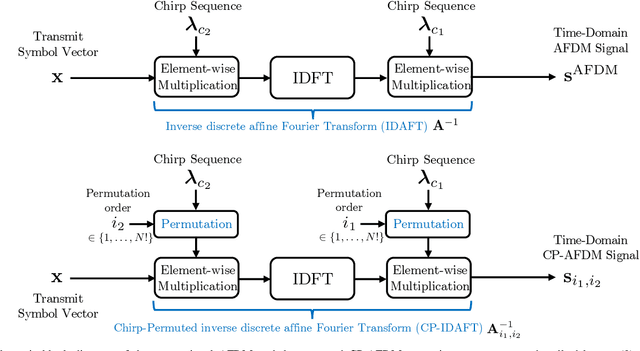
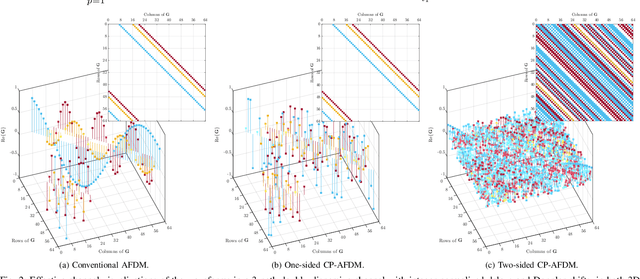
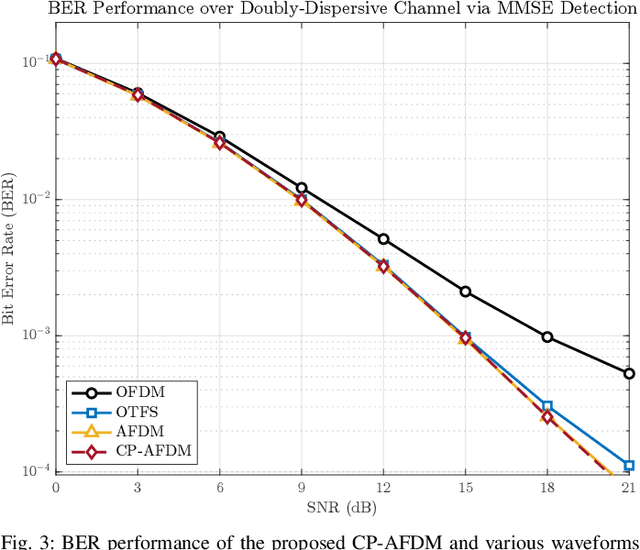
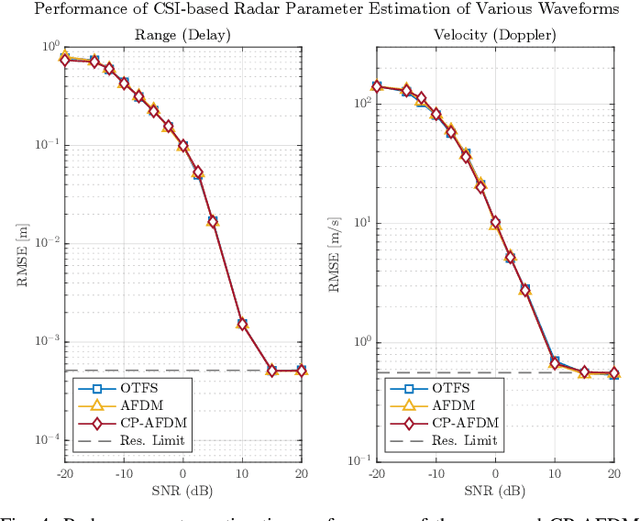
We present a novel multicarrier waveform, termed chirp-permuted affine frequency division multiplexing (CP-AFDM), which introduces a unique chirp-permutation domain on top of the chirp subcarriers of the conventional AFDM. Rigorous analysis of the signal model and waveform properties, supported by numerical simulations, demonstrates that the proposed CP-AFDM preserves all core characteristics of affine frequency division multiplexing (AFDM) - including robustness to doubly-dispersive channels, peak-to-average power ratio (PAPR), and full delay-Doppler representation - while further enhancing ambiguity function resolution and peak-to-sidelobe ratio (PSLR) in the Doppler domain. These improvements establish CP-AFDM as a highly attractive candidate for emerging sixth generation (6G) use cases demanding both reliability and sensing-awareness. Moreover, by exploiting the vast degree of freedom in the chirp-permutation domain, two exemplary multifunctional applications are introduced: an index modulation (IM) technique over the permutation domain which achieves significant spectral efficiency gains, and a physical-layer security scheme that ensures practically perfect security through permutation-based keying, without requiring additional transmit energy or signaling overhead.
Metasurfaces-Integrated Doubly-Dispersive MIMO: Channel Modeling and Optimization
Jun 17, 2025The doubly-dispersive (DD) channel structure has played a pivotal role in wireless communications, particularly in high-mobility scenarios and integrated sensing and communications (ISAC), due to its ability to capture the key fading effects experienced by a transmitted signal as it propagates through a dynamic medium. However, extending the DD framework to multiple-input multiple-output (MIMO) systems, especially in environments artificially enhanced by reconfigurable intelligent surfaces (RISs) and stacked intelligent metasurfaces (SIM), remains a challenging open problem. In this chapter, a novel metasurfaces-parametrized DD (MPDD) channel model that integrates an arbitrary number of RISs, while also incorporating SIM at both the transmitter and receiver is introduced. Next, the application of this model to some key waveforms optimized for DD environments -- namely orthogonal frequency division multiplexing (OFDM), orthogonal time frequency space (OTFS), and affine frequency division multiplexing (AFDM) -- is discussed. Finally, the programmability of the proposed model is highlighted through an illustrative application, demonstrating its potential for enhancing waveform performance in SIM-assisted wireless systems.